If you know your friend’s boyfriend or husband is cheating on her, is it your bound duty to inform her of this fact? In this particular case, I don’t know him very well, or maybe I’d try to talk to him about it. I’ve been in this situation (knowing about the affair) before, and both times the cheated-on wife/girlfriend was very angry that people knew her man was cheating before she did. Felt like a fool. But honestly, who am I to decide she ought to know? Another guy I know was cheating on his wife, but ultimately broke off the affair and went back to her. In that situation, I’m not sure she’d have been better off knowing. She has the man, and he’s making an effort to work things out even if he is living a lie. What do you think: is full disclosure always best?
Filed under: issues,News — posted by Breakup Girl @ 11:01 am
Today’s New York Times featured a lengthy article about how today’s mix-and-rematch post-divorce parents with kids make it work: not by marrying and moving everyone, and Ann B. Davis as Alice, into the same ranch house at 1164 Morning Glory Circle, but…close. As a means of preserving their own semi-independence, and sparing the kids an extra intrusion, they’re moving — well, into different ranches on the same circle, say. Or even: same house; different floors, different doors.
In the articles first example, the triple-hyphenate Curtis-Hetfield-Petrini household (two divorced parents, now each others’ partners; three kids among them), for instance, lucked into a two-family town house in Brooklyn. My initial crabby thought: “Well, of course it works great for them. They have a ‘sleek bamboo kitchen.'”
But (a) no fair, as we all know that when it comes to discord, creature comforts are more often cause than antidote, and (b)Â the article goes on to describe many types of blendy families in many shapes, forms, places, and real estates. And the broadest points are well-taken. First, the economic reality of a post-Carol world:
…What’s really driving the practice of committed couples with children living in separate abodes, [said Susan Stewart, a sociologist at Iowa State University who studies how families form and change over time], “is that middle- and upper-income women have their own money and independence. They are working, and can live on their own.â€
And — most important — this, also from Stewart:
“The complexity of families is the real story. Family life is not what it was. The divorce rate†— roughly half of all first marriages still end in divorce — “has been high and stable since the 1980s. The majority of these people go on to marry or cohabit. Then there’s the change in custody patterns, with more and more fathers desiring more time with their children, if not full or shared custody. The traditional family — the married-couple-biological-children family — is in the minority.â€
Filed under: books,issues — posted by Paula @ 11:06 am
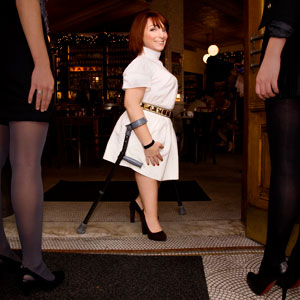
Lauren Ruotolo is a gorgeous redhead with a great job–Director of Entertainment Promotions for the Hearst Corporation–a glam wardrobe, a cool boyfriend, and a hot new book about getting a leg up in life, no matter what size your legs happen to be.
In addition to being a funny (anecdotes about LL Cool J!) and moving autobiography about coping with and triumphing over her condition, Ruotolo’s book is an old-fashioned, Dale Carnegie-esque motivational work organized around themes like “Rejection can be your greatest ally,” “Being different is a gift,” and “Avoid the word ‘no’.†She encourages readers of all abilities to get over self-doubt, self-consciousness–just get over themselves, period–and create happiness on their own terms.
We spoke to the vivacious author at her office in the Hearst Tower.
So, the advice—both life- and dating-related—in your book is geared towards a mainstream audience.
Right.
I’m wondering if you have any specific dating advice for people who have physical challenges or physical differences.
I think that the first piece of advice–and it’s not just for people with physical disabilities or mental disabilities–is that you have to love yourself in order for someone to love you.That was something that I had to learn–that I had to love myself the way that I wanted to be loved by somebody, and I had to learn to be comfortable with knowing that I am different from other people, that my body looks different, that when it comes to sex or being intimate with somebody that it’s going to be a little bit different, so I think that I had to understand all those aspects and love every aspect of who I was before I could allow somebody in. Iwas always so insecure about it.
And I think that you become insecure when you’re dating, anyway–everybody is insecure! But it really becomes difficult when there’s something different about you.I hope that I teach in the book–for people to really love themselves–and, like I said, love themselves like you want to be loved.
Your experiences with online dating were not very positive.
No! (Laughs.) Not at all!Oh my god, it was such a nightmare!I hope to never have to do that again in my life. When it comes to online dating, yes, you want to put yourself out there, and put as much information about yourself up front. But as I wrote in the book, how I have always seen myselfis not really as a “handicapped†person. I knew that if I presented myself as a girl walking with crutches, that’s all anyone would see, and I would be labeled as a “Girl With Crutchesâ€â€¦
You mention in the book that you entered therapy, and the key lesson there for you was acceptance. How would you define “acceptance�
Acceptance, for me, was when I stopped hiding. I said, “I love myself, I have a family who loves me, I have friends that love me, and the next man I meet is gonna love me for me and I’m not gonna hide behind a barstool, and I’m not going to hide behind a photo online. I’m just gonna put myself out there and see what happens.â€
And I did–I met [current live-in boyfriend] Nelson on a staircase.So it was that acceptance and getting rid of that insecurity in my head that got me there.I was always so strong in so many other ways—but when it came to relationships–well, like I said, I think everyone has these fears. Because society is like, all right, you get to a certain age, girls, and you gotta find that husband, and you gotta have babies, and that’s your life! When you’re a child, you dream about your wedding–you know, there’s this idea promoted by magazines, especially here at Hearst, and at Seventeen magazine, that they’re like two of the greatest moments in a girls’ life: her prom, that she’ll always remember, and her wedding.
“Who are you gonna take to your prom?Who are you gonna marry?â€(Laughs) So it’s just always a constant conversation that makes us all nervous, but we all have to accept who we are, and that was really what I learned in therapy.
The wedding thing–is that something that has been in your mind pressuring you, or have you let that go?
I think as Nelson and I get closer, and as I get older, it’s something that I’ve thought about a lot more often than I ever did in my life–
–but, because you have the relationship–
Right, because I have the relationship–
–not because you’re thinking about the dress.
Exactly!(Laughs) Well, now that I’m in the relationship, I do think about the dress!
Ha! Tell me about Glamour Gals Foundation.
Oh, Glamour Gals is such a great organization. It’s an intergenerational organization that brings teen girls and elderly women together. The teen girls provide complimentary makeovers and facials and, more than anything, companionship to the elderly women.
My great-grandmother was in a home, so I know–when I would come visit, she would want to get dressed and she would want to put lipstick on and make herself presentable. With women, from the time we’re three years old, we want to wear lipstick ‘til the time we’re 93. We want to wear makeup!It just makes you feel good.And I think that it’s such a great opportunity for community service for girls.You know, when else are you really going to teach them that there are these wonderful older women out there, unless they have somebody in their family. And I think it really makes teens feel good about what they’re doing, and obviously the ladies feel great about themselves.So I’m really happy to be part of the organization.
The way that I found out about it was when my article in Marie Claire came out in March of 2009.The president and founder Rachel Doyle read it and contacted somebody here at Hearst called Susan Schultz who was on the advisory board and was like “Do you know this girl? I would like to nominate her for our Glammy, for most glamorous gal of the year.†And they did, and I accepted, and it was such a wonderful honor!
And now I’m on the advisory board, and I’m heading up their first gala in February.
Do you have any plans for a follow-up book?
I really want to do a children’s book.Children—at least from my understanding and the research that I’ve done on the street where children stare at me—don’t see racial differences these days because it’s everywhere.So, they have black friends, they have white friends, they have Puerto Rican friends, they have Chinese friends, and they don’t see the difference anymore, which is wonderful.But they still see the obvious physical differences of people with different abilities.And I think parents get nervous because kids are just outspoken.Not because they’re mean, because they just want to know!
They see somebody who’s different, and say, “Mommy, why is that lady so short?†or “What are those shiny things that she walks with?â€And parents get embarrassed.And I see a lot of times where the parents are like “Shh!†or they just pull them away, and they don’t wanna notice it.
And that’s not the way.I really want to help children understand those differences.
(To read more about people living with short stature, click here.)
This has gotta be one of the best examples of art imitating life we’ve ever seen: Ships That Pass is, to use the site’s own verbiage, “a collection of fake, imaginary and literary missed connections posted to Craigslist and then re-posted here [at Ships That Pass’ Tumblr page] with real responses.” The brainchild of Brooklyn-based poet Brett Fletcher Lauer (who’s written an awesome guest post about the endeavor here), it’s what an online performance-art installation commissioned by Margaret Mead might look like. Or a post-millennial, dot-com remake of those Griffin & Sabine pop-up-ish epistolary epics of my romantically angst-addled adolescence. (Anybody else remember those?) [YES!!!! Sob! — BG]
Here’s how it works: Myriad poets, writers and artists craft ersatz missed-connection posts, complete with the fictitious posters’ ages and the appropriate tag (m4w, w4m, m4m, w4w). These are uploaded to Craigslist as any real missed-connection missive would be; simultaneously, they appear on Ships That Pass. Should any unsuspecting Craigslist readers reply to the post, those emails are readable on Ships That Pass as follow-ups to the original. On the flip side, should a suspicious Craigslister flag a post for removal — as has happened a handful already — news of that post’s untimely demise is likewise reported. A missed connection that receives no action at all (overwhelmingly the case) is earmarked with a little sad face like the Zoloft mascot, informing Ships That Pass readers of “Another Missed Connection Missed.”
As anyone who’s read missed connections for sport knows, it’s the unknowable of “But did Girl with Nose Ring Wearing Military Jacket ever hear from Guy Reading The Tender Bar on the Uptown 2 Train?” that feeds their addictiveness. That, and the messages’ unbridled sentimentality. Whereas Craigslist’s other alt-personals, Casual Encounters and Misc. Romance, can depress the hell out of anyone hoping for a shred of flirtation, intrigue, chivalry or grammar to hang onto, Missed Connections is a bastion of well-intentioned, intelligently penned, old-fashioned courtship. One’s for nutjobs; the other’s for l’amour fou.
Enjoying the newly-habit-forming element of “Is it live or is it Ships That Pass?” probably won’t bode well for anyone’s to-do list. And then there’s the question of whether Missed Connectioning under false pretenses is ultimately setting up a stranger for disappointment. Judging by the responses so far, though, it seems that what drives people to reply isn’t the expectation that they’ve been identified/fancied/remembered. It’s their complicit understanding that the heart wants what it wants, and their immutable belief in art for art’s sake.
I try to be supportive, but a friend of mine is really beginning to tax my patience. She has fallen hard for a long-time friend of several years. Spending all their free time together, they are virtually inseparable. All their co-workers and family and friends fully expect them to get married. My friend thought that they would, too. So of course, something happens: he reveals to her that he is, in fact, gay. He has not come out but lives a double life. So now that he has entrusted her with his secret, he torments her constantly with every detail about his latest love exploits, even though he knows how she feels about him. What is worse is that he uses her as a cover–he has gone so far as to tell people that she is his girlfriend in order to keep his sexuality a secret. My friend goes along with it and rationalizes by telling herself, and me, that she doesn’t care what people think. If she doesn’t mind participating in this deception, it is not my place to say. But it does bother her, and she is calling me all the time to complain about it. It is always the same story. Of course she refuses to confront him, but continues to call me about it. She might as well just periodically play a recording of herself to me at this point. I have told her that she needs to decide what she wants and just stick by it, but it has become evident that she would prefer to do nothing and complain. I cannot tell her what to do with respect to him, but I appeal to Breakup Girl to help me figure out what I can do–I can’t stand to hear the same story over and over anymore–and it’t not like I have time to kill, but I also don’t want to abandon her–she has not discussed this with anyone else with the exception of one individual, and those discussions just ended in shouting matches.
For around a year a girl who I’ve become really good friends with has been in love with this guy from overseas. We both are mad internet fans (she met this guy on chat). I know it probably seems really interfering but I am so worried about her because she gets so upset whenever she doesn’t hear from him for a while… this may sound crazy to non-net addicts (are there actually any?!?!) but there it is. I’ve been trying to be supportive of her but I’m getting really angry with him because I’m the one (along with another close friend) who’s left to comfort her when he doesn’t e-mail/come into chat/phone for extended periods of time. THEN when he DOES talk to her it’s always about bloody computers! (He works with them.) It is really bewildering for her because one moment he says he loves her and wants to be with her blah blah blah and that he wants to come over here soon and the next he pulls on this “I’m too old for you… you need to experience more in your life!!!” I wish he’d just be consistent and let her know whether it’s yay or nay. I really don’t know what to tell her anymore and I’m looking for advice.
Filed under: News,Psychology — posted by Kristine @ 10:58 am
When scientists — arguably the most logical of humans — try to make sense of love, interesting things are bound to happen. As Albert Einstein concluded: “Gravitation is not responsible for people falling in love.†(No one’s ruled out inertia, entropy, or nuclear fusion.) Traditionally, of course — metaphorically or otherwise — we trace the origin of love to our hearts. Thankfully, though, Syracuse University Professor Stephanie Ortigue suggests that our head has something to do with it, too — and not just when it’s over our heels.
In the new study “The Neuroimaging of Love,†Ortigue reveals that “12 areas of the brain work in tandem to release euphoria-inducing chemicals such as dopamine, oxytocin, adrenaline and vasopression.†Basically, “falling in love can elicit not only the same euphoric feeling as using cocaine, but also affects intellectual areas of the brain.†Apparently, when it comes to love, we can go from zero to sixty in 1/5th of a second — meaning that euphoria can enter our system as quickly, if not faster, than a controlled substance.
So falling in love is like being on cocaine. It happens real fast, you’re on this crazy high — and then you come down. Interestingly enough, cocaine was once an ingredient in Coca Cola. Coca Cola was first introduced as a patent medicine “for all that ails you.†Since cocaine isn’t legal and has long been removed from Coca Cola, maybe all we need is love?
Dr. Sean Mackey, chair of the pain management division of Stanford University, might agree. Writing recently in Time, Alice Park explores Mackey’s research into to what degree love might “influence how we experience physical pain.” Mackey discovered that when people who reported being in the first stages of “new and passionate love” were shown pictures of their various pumpkins and pookies, they could withstand greater amounts of pain — even more so than when occupied by mental tests or when shown photos of equally attractive friends.
While I am all for love as a potential wonder-drug, one of my questions is: why only romantic love? Would throwing a different kind of love — say parent/child — into the pain equation garner the same results? Isn’t that love just as mind-altering? Nope, turns out. Well, not in the same way.
Ortigue’s study found that the reason parent-child love would likely not have the same effects on pain is that different parts of the brain are stimulated by different kinds of love: “Passionate love is sparked by the reward part of the brain, and also associative cognitive brain areas that have higher-order cognitive functions, such as body image.”
Parent-child love wouldn’t reduce pain physically because it doesn’t stimulate the reward center. However, that’s not to say that a parent wouldn’t be able to endure more pain should their child be in danger. In essence, Mackey’s study is strengthened by Ortigue’s assertion that the brain releases chemicals akin to cocaine to stimulate romantic love, because like cocaine, love works back and forth with the brain as it heightens certain things and dulls others. Love engages “our very deep, old and primitive reptilian system that involves basic needs, wants, and cravings.”
Since romantic love allows us to withstand more pain, perhaps it is the reason humans survive. While the end of love can hurt, to the point of making people lovesick, the euphoria of being in love keeps us coming back, much like cocaine keeps an addict coming back — all ensuring that we continue the species. From an evolutionary standpoint, the emergence of romantic love in humans may be all about survival of the fittest – rewarding us for the formation of potentially strong alliances with our mates and, as shown by Mackey allowing us to withstand greater amounts of pain, which from a primitive standpoint would have been useful in a fight with that mastodon.
Be thankful. Biology is looking out for us in more ways than one.
Arianna Huffington introduces a new section, HuffPo Divorce:
“I’ve always thought that, as a country, we do a lousy job of addressing how we can do divorce differently — and better. Especially when there are children involved. That’s why I’m so excited about the launch of HuffPost Divorce.”
Anything that can help families cope with divorce is a good thing. Better still, a considered collection of personal, legal, practical, and psychological pieces that approach and elucidate divorce in the myriad ways… now that sounds really kinda awesome! Inspired by Nora Ephron, fleshed out by family law professionals, essays and advice, and authors of topical books.
It’s almost impossible not to feel a tiny tad jaded, thinking about divorce-affected people as a publishing niche, but that’s exactly what we are. Half the population! I wonder if this is the beginning of more like this.
Meanwhile, I welcome the story and information sharing that may well become a resource for one of life’s most changing events. As a person who went through a starter marriage in her twenties, and who is a child of divorce herself (actually, once I counted and there have been no fewer than 12 divorces in my immediate family) I’d love to dip in now and again to say, find ways to manage doubled parental visiting guilt and the impending holidays!
Breakup Girl
is the superhero whose domain is LOVE or the lack thereof!
Her blog combines new comics, observations and dating news with
classic advice letters--now blogified for reader feedback!





 e-mail to a friend in need
 Handling the truth on April 27, 1998…
 .
.
 pop-up-ish epistolary epics of my romantically angst-addled adolescence. (Anybody else remember those?) [YES!!!! Sob! — BG]